pacman::p_load(ggstatsplot, tidyverse)Hands on Exercise 4
Load and Install R Packages
Importing the data
exam_data <- read_csv("data/Exam_data.csv")

head(exam_data, 10)
# A tibble: 10 × 7
ID CLASS GENDER RACE ENGLISH MATHS SCIENCE
<chr> <chr> <chr> <chr> <dbl> <dbl> <dbl>
1 Student321 3I Male Malay 21 9 15
2 Student305 3I Female Malay 24 22 16
3 Student289 3H Male Chinese 26 16 16
4 Student227 3F Male Chinese 27 77 31
5 Student318 3I Male Malay 27 11 25
6 Student306 3I Female Malay 31 16 16
7 Student313 3I Male Chinese 31 21 25
8 Student316 3I Male Malay 31 18 27
9 Student312 3I Male Malay 33 19 15
10 Student297 3H Male Indian 34 49 37One-Sample Test: gghistostats()
set.seed(1234)

gghistostats(
  data = exam_data,
  x = ENGLISH,
  type = "bayes",
  test.value = 60,
  xlab = "English scores") +
  theme_classic() +
  theme(plot.background = element_rect(fill = "#F8F3E6", color = "#F8F3E6"))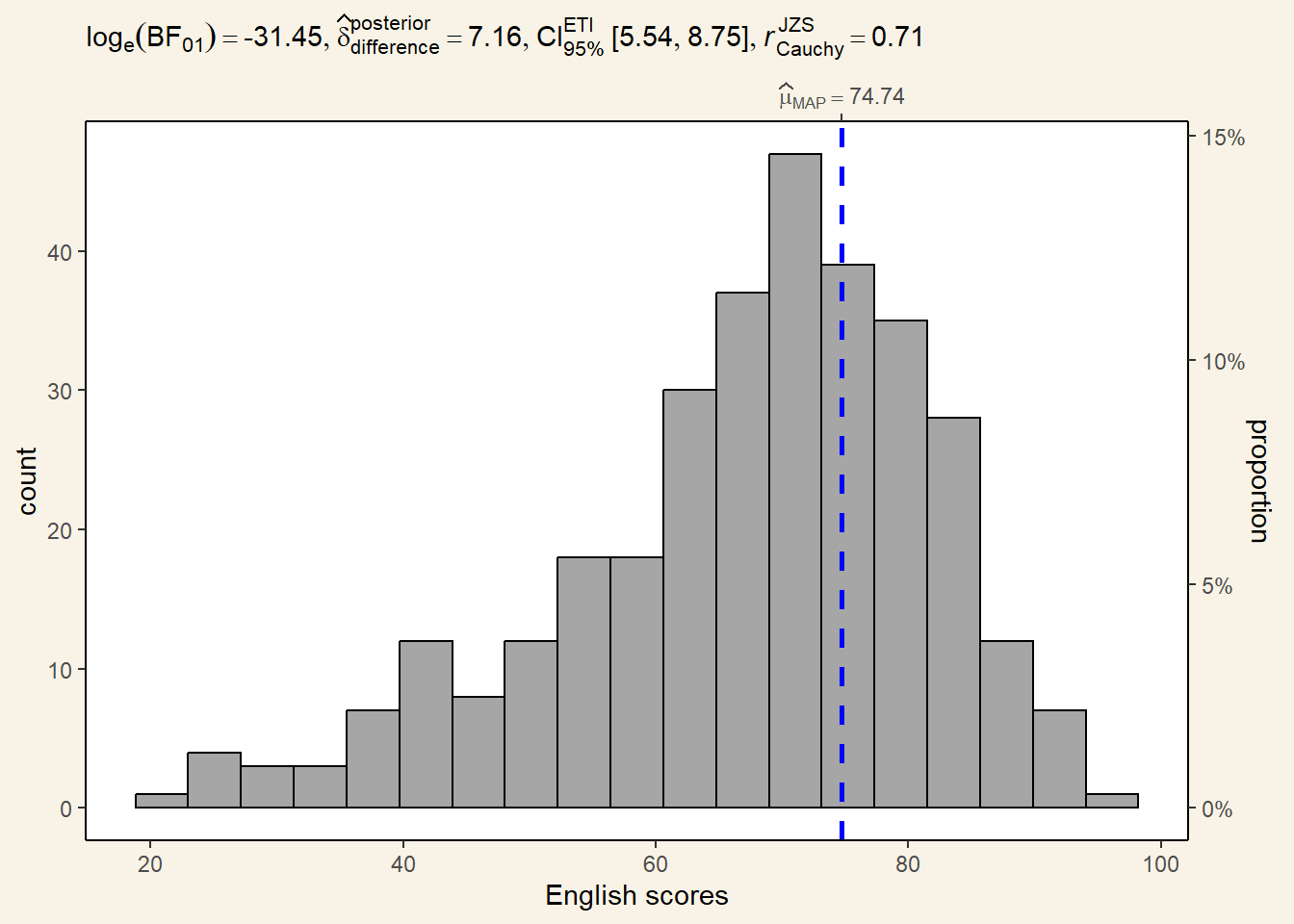
Bayes factor is the ratio of the likelihood of one particular hypothesis to the likelihood of another. It can be interpreted as a measure of the strength of evidence in favor of one theory among two competing theories.
Two-Sample Test of difference in means: ggbetweenstats()
ggbetweenstats(
  data = exam_data,
  x = GENDER,
  y = MATHS,
  type = "np",
  messages = FALSE) +
  theme_classic() +
  theme(plot.background = element_rect(fill = "#F8F3E6", color = "#F8F3E6"))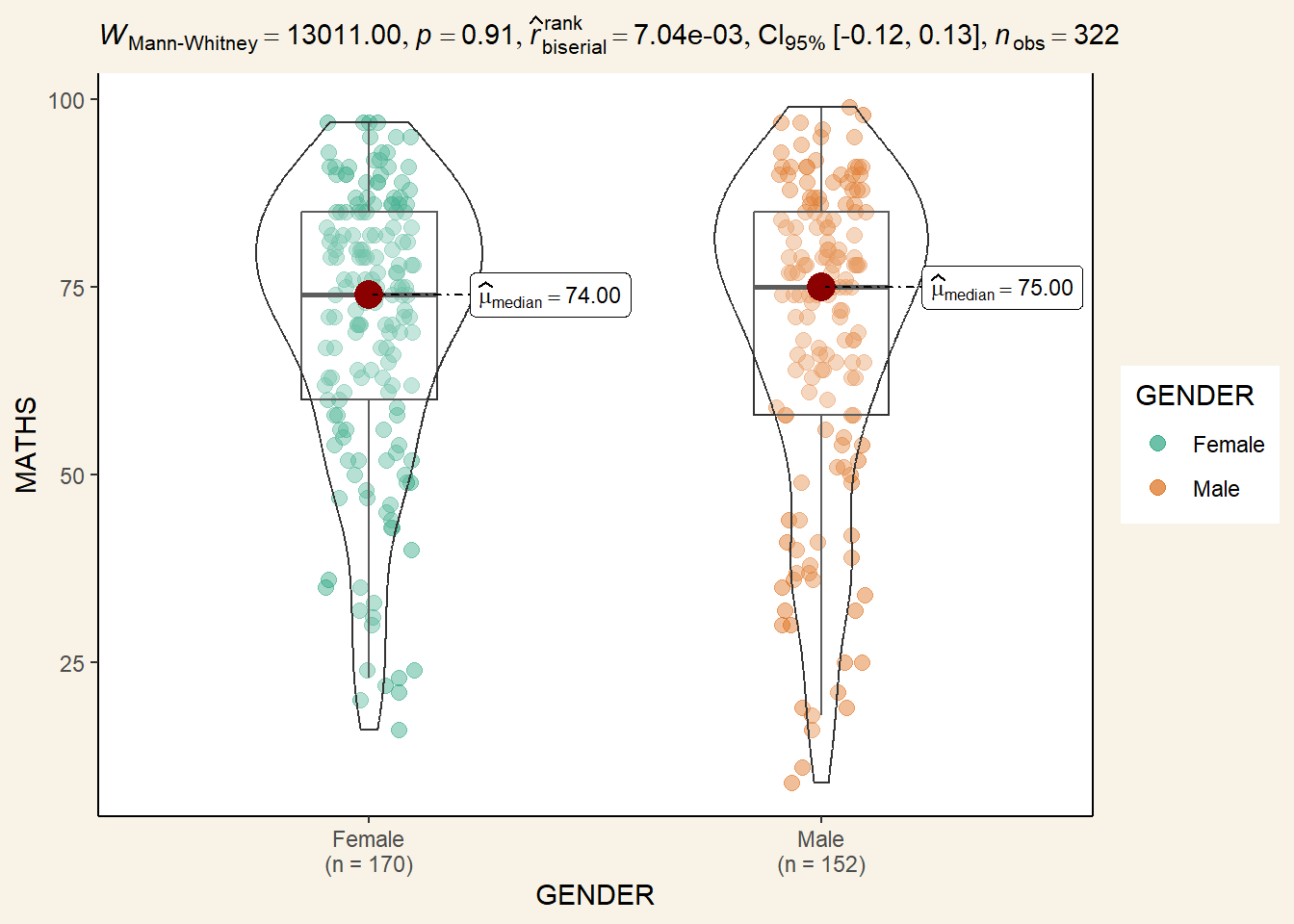
One-way ANOVA Test of difference in means: ggbetweenstats()
ggbetweenstats(
  data = exam_data,
  x = RACE,
  y = ENGLISH,
  type = "p",
  mean.ci = TRUE,
  pairwise.comparisons = TRUE,
  pairwise.display = "s",
  p.adjust.method = "fdr",
  messages = FALSE) +
  theme_classic() +
  theme(plot.background = element_rect(fill = "#F8F3E6", color = "#F8F3E6"))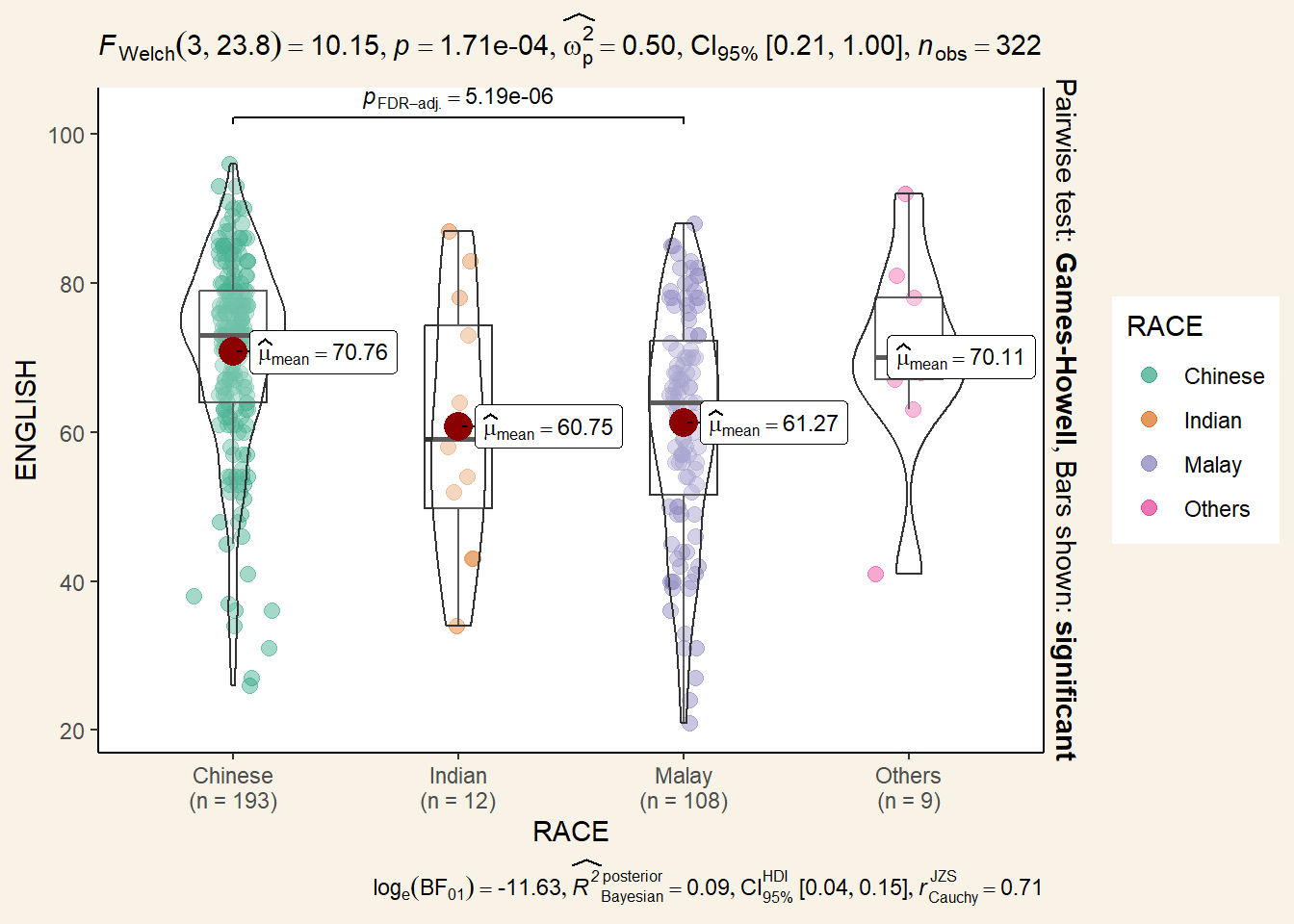
Correlation Test: ggscatterstats()
ggscatterstats(
  data = exam_data,
  x = MATHS,
  y = ENGLISH,
  marginal = FALSE) +
  theme_classic() +
  theme(plot.background = element_rect(fill = "#F8F3E6", color = "#F8F3E6"))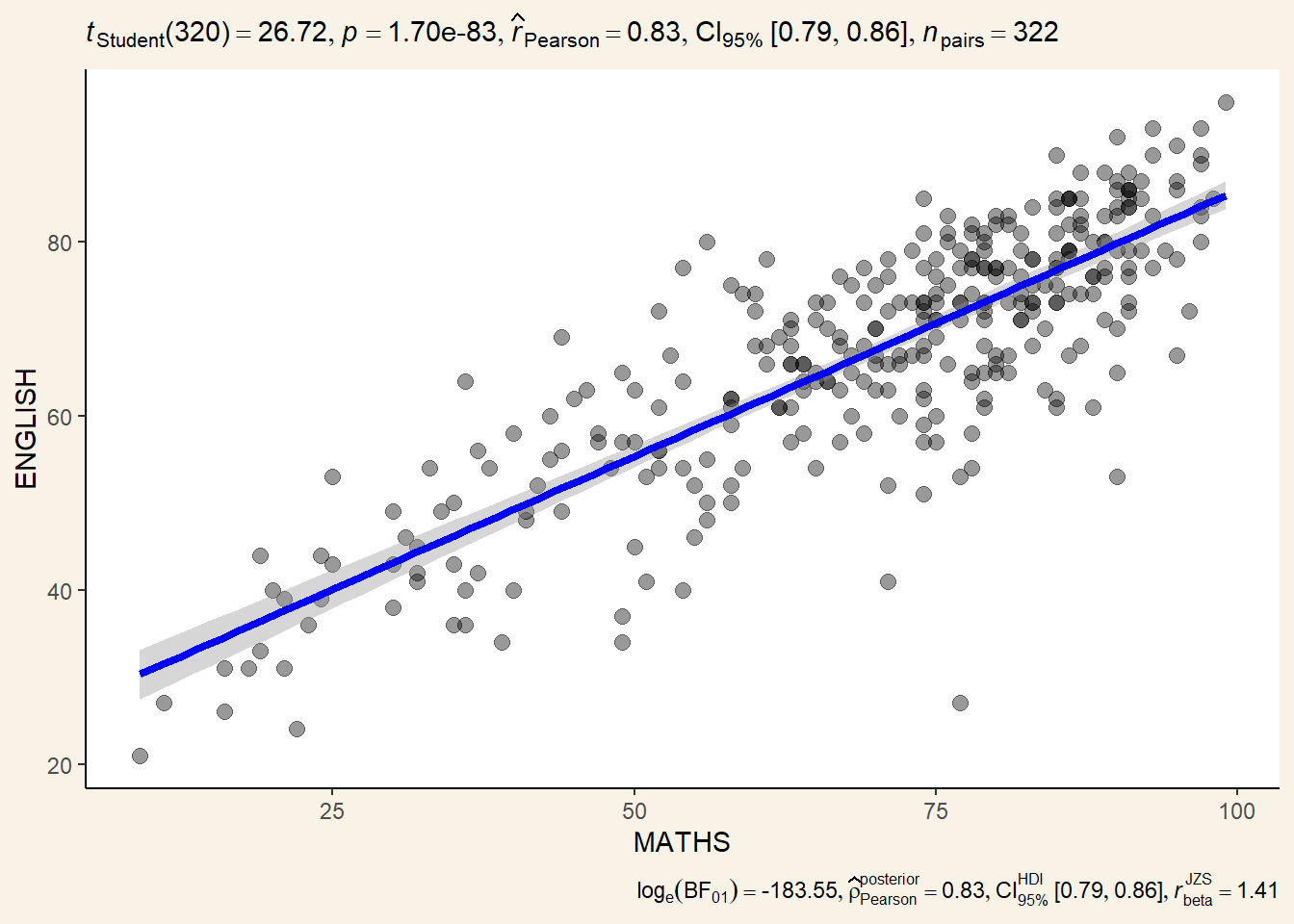
Association Test (Dependence): ggbarstats()
exam1 <- exam_data %>%
  mutate(MATHS_bins =
           cut(MATHS,
               breaks = c(0,60,75,85,100))
)

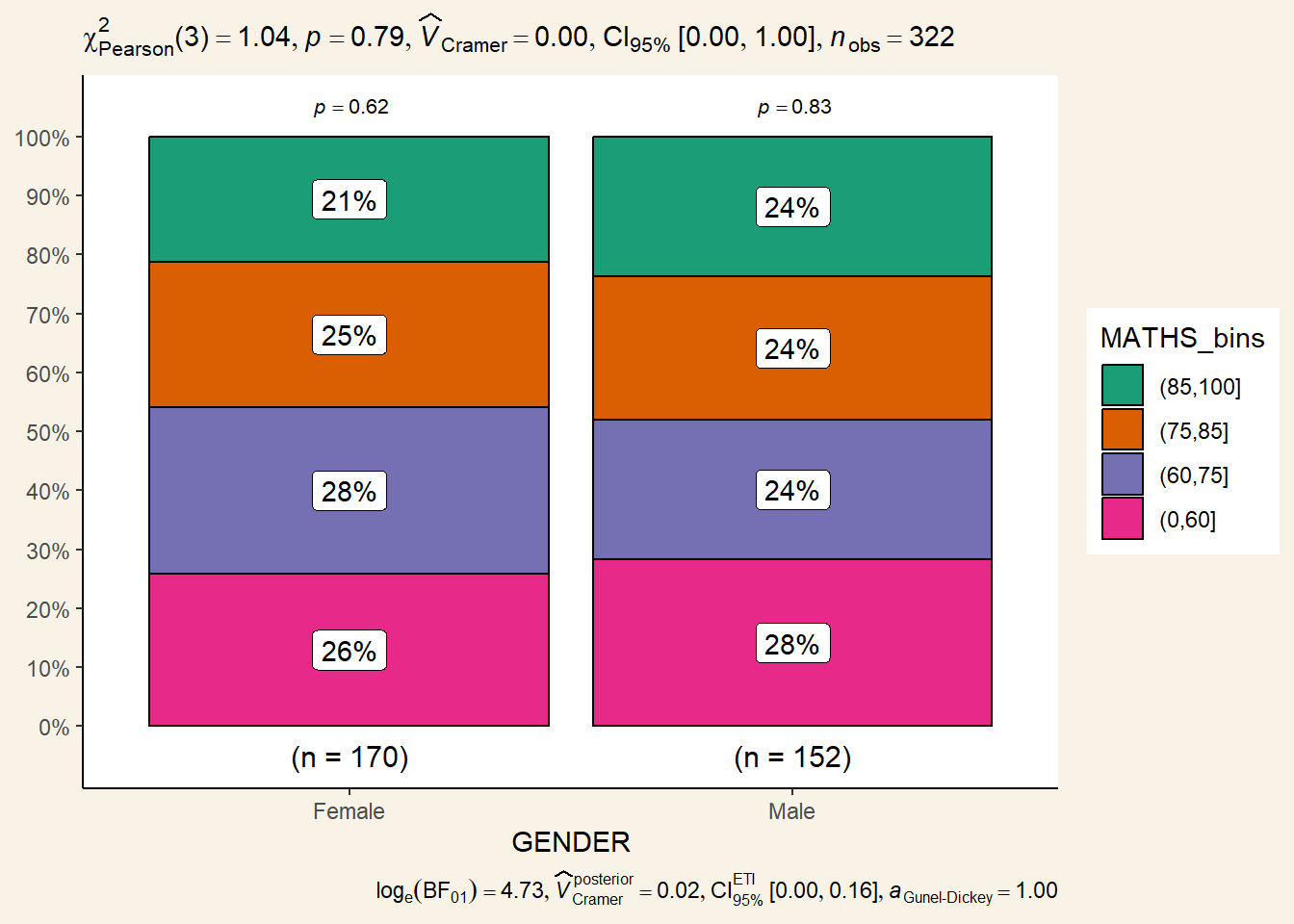
ggbarstats(exam1,
           x = MATHS_bins,
           y = GENDER) +
  theme_classic() +
  theme(plot.background = element_rect(fill = "#F8F3E6", color = "#F8F3E6"))